By Suresh Nautiyal Greenananda
During my travels through Singapore in February 2026, I observed the enduring threads that bind this island to India—threads that are maritime, cultural, and deeply human. In Little India, the scents of spices and incense mingle with the aroma of artisanal coffee from modern cafés. Street vendors, contemporary shops, and traditional craft stores coexist, while Tamil, Hindi, and other Indian languages rise above the hum of Mandarin, Malay, and English.
Even amid gleaming skyscrapers, efficient MRT stations, and disciplined urban planning, the pulse of centuries-old maritime connections remains tangible. The relationship between India and Singapore has never been merely diplomatic; it moves like tides—civilisational in depth, shaped by colonial crossings, strengthened by commerce, and sharpened by modern strategy.
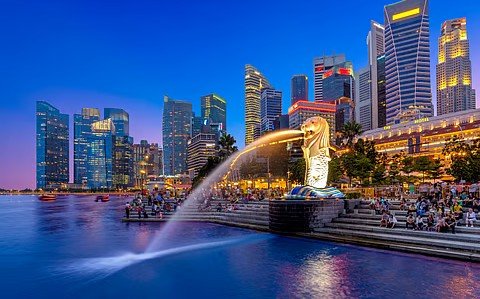
Stand at the edge of the Singapore Strait at dusk, and ships move across the dark waters like illuminated constellations. Tankers, container vessels, and naval craft follow invisible routes shaped by geography and history. Long before embassies and passports, the sea carried people, goods, beliefs, and ideas between the Indian subcontinent and Southeast Asia.
Early Maritime Bridge
Long before Singapore became a modern city-state, the Malay world was already in dialogue with India. Monsoon winds carried spices and textiles, but also language, sacred ideas, and artistic motifs. Sanskritic vocabulary, temple architecture, and devotional traditions travelled across the seas and found new expressions in Southeast Asian societies.
Within this maritime world lay the island known in the fourteenth century as Temasek. Though modest in scale, it functioned as a strategic trading node linking the Indian Ocean with the South China Sea. The Bay of Bengal was never a boundary; it was a corridor through which commerce, culture, and imagination flowed.
Walking through modern Singapore, traces of these ancient exchanges remain visible—temples, markets selling Indian textiles and spices, and street names echoing earlier migrations.
Colonial Singapore and Indian Migration
The modern transformation of Singapore began in 1819 when Stamford Raffles, acting for the British East India Company, established a trading post on the island. The port soon became integrated into the administrative and commercial networks of British India. For decades it was governed from Calcutta and briefly linked to the Bengal Presidency, reflecting the close colonial connection between India and Singapore.
Through this imperial circuit came Indians in many roles. Convicts cleared forests and built roads and public buildings. Sepoys maintained colonial order. Tamil labourers worked along docks and construction sites, while Sikh policemen became visible symbols of authority. Chettiar financiers supported trade and plantations with their banking networks.
These communities were foundational to the colony’s growth. Temples, markets, and neighbourhoods gradually formed around Serangoon Road, giving rise to what would later become Little India. Even today, walking through areas like Tekka Market, one senses the continuity of this cultural memory.
Yet colonial rule also imposed rigid hierarchies. Administrative systems categorised populations by race and function, shaping the social structures that would later influence Singapore’s multicultural framework.
War and Revolutionary Echoes
The Second World War disrupted imperial order. In 1942, Singapore fell to Japan, shattering the myth of British invincibility. During the occupation, the city became an important stage for India’s anti-colonial struggle.
Indian nationalist leader Subhas Chandra Bose arrived in Singapore to lead the Indian National Army. Here he proclaimed the Provisional Government of Free India—Azad Hind—and mobilised Indian prisoners of war and civilians in the hope of liberating India from colonial rule.
At Esplanade Park, Bose laid the foundation for the INA War Memorial, honouring soldiers who fought for independence under the ideals of unity, faith, and sacrifice. Although the memorial was later dismantled after the war, a historical marker now commemorates the site. It stands as a reminder that struggles for freedom often transcend geography.
Nation-Building and Multiculturalism
After the war, Singapore entered a period of intense political change—labour movements, ideological contestation, and constitutional negotiations eventually led to independence in 1965. Under Lee Kuan Yew and the People’s Action Party, the young republic embarked on disciplined nation-building.
Multiracialism became a central national principle. Tamil was recognised as one of the four official languages alongside English, Mandarin, and Malay, reflecting the long-standing presence of the Indian community.
Although the Chinese population forms a majority, Indian Singaporeans have played important roles in law, medicine, education, politics, and business. Cultural traditions—from classical dance to cuisine—have become part of Singapore’s everyday cultural mosaic.
The Contemporary Partnership
In the twenty-first century, India and Singapore interact not as colony and outpost but as sovereign partners within the evolving Indo-Pacific. Singapore has become one of India’s major sources of foreign direct investment, supporting infrastructure, technology ventures, and urban development.
Agreements such as the Comprehensive Economic Cooperation Agreement have strengthened economic and professional exchanges, linking financial centres in Singapore with innovation hubs in cities like Mumbai and Bengaluru.
Geography further deepens this partnership. Singapore sits near the Strait of Malacca, through which a large portion of global trade and energy flows. For India’s Act East policy, Singapore serves as both gateway and strategic partner within Southeast Asia.
Memory and the Maritime Future
In the heart of Little India stands the Indian Heritage Centre, a museum dedicated to tracing the long history of Indians in Southeast Asia. Its galleries move from ancient maritime exchanges to colonial migration and modern nation-building, reminding visitors that history here is not distant but living.
Ultimately, the relationship between India and Singapore is not defined by a single era. It has moved through ancient maritime exchange, colonial administration, wartime upheaval, postcolonial nation-building, and modern strategic cooperation.
Standing again at the Singapore Strait, watching ships pass through the night, one senses this layered continuity. The vessels carry commerce and technology, yet within their movement echoes an older rhythm—the journeys of traders, labourers, soldiers, revolutionaries, and entrepreneurs who crossed these waters long before.
India and Singapore remain connected by the sea—two nations woven together by memory, commerce, and the enduring currents of history.
