— Suresh Nautiyal Greenananda
Situated along Campbell Lane in the vibrant precinct of Little India, the Indian Heritage Centre stands not merely as a museum but as a bridge between memory and modernity, migration and nationhood. Opened on 7 May 2015 under the stewardship of the National Heritage Board, the Centre narrates more than the story of a community; it illuminates how journeys across oceans gradually become part of Singapore’s shared national consciousness.
Amid Little India’s colour-filled streets—garlands swaying above shopfronts, spices scenting the air, and temple bells echoing through commerce—the Centre functions as both anchor and compass. It anchors a rich heritage while encouraging reflection on identity, diversity, and belonging in the twenty-first century.
Ancient Maritime Connections
To understand the deeper story behind the Indian presence in Singapore, one must look far beyond the colonial period. Long before European ships entered Asian waters, vast maritime networks connected India, China, Africa, and Southeast Asia. The Indian Ocean was not a barrier but a bridge.
From the early centuries of the Common Era, traders, monks, and scholars crossed monsoon-driven sea routes carrying not only spices and textiles but also ideas, languages, and artistic traditions. Religions such as Hinduism and Buddhism travelled eastward, shaping civilisations like Angkor, Srivijaya, and Majapahit. These exchanges were never simple cultural transfers; local societies adapted and reshaped them according to their own traditions.
Within this wider Asian network lay the island later known as Singapore. In the fourteenth century it was remembered as Temasek, a modest trading node linking the Indian subcontinent, China, and the Malay world. For centuries it remained part of the Johor-Riau trading sphere until a decisive moment arrived in 1819.
Colonial Port and Migration
In that year, Stamford Raffles established Singapore as a British free port under the British East India Company. The island quickly became a major hub within global maritime trade networks. Migration accelerated as labourers, traders, soldiers, and professionals arrived from many parts of Asia.
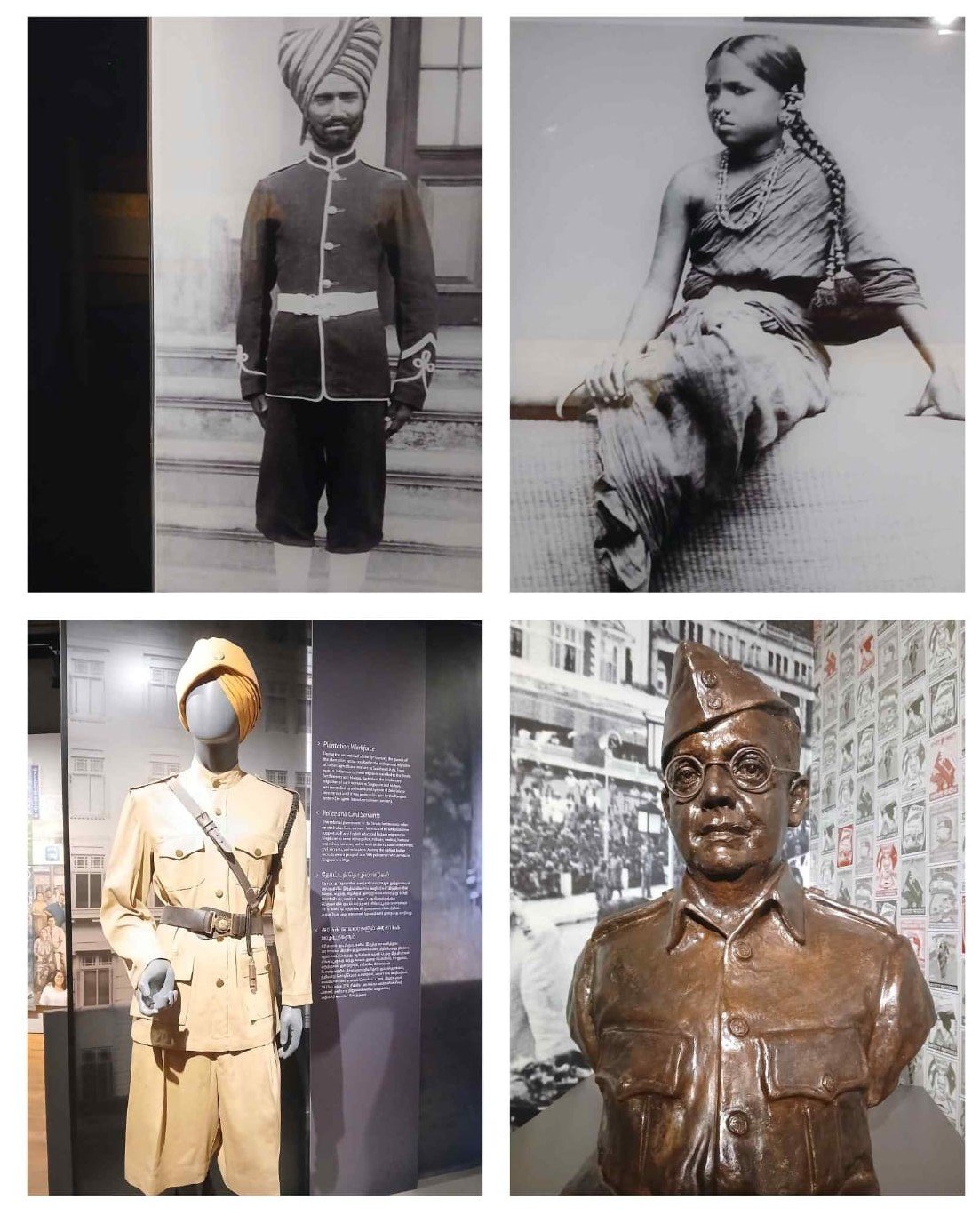
Indians formed one of the most diverse migrant communities. Tamils, Punjabis, Gujaratis, Bengalis, Malayalis, and Sindhis came in different waves and under different circumstances. Some arrived as traders or professionals seeking opportunity in the open port. Others came under indenture or as soldiers in colonial regiments.
By the nineteenth century, distinct settlement patterns had emerged. Traders and moneylenders gathered in Chulia Kampong around Chulia Street and Market Street. Port workers lived near Tanjong Pagar, while shipbuilders and artisans worked along North Bridge Road. Textile merchants operated in High Street and Arab Street, and naval base workers later settled in Sembawang. Gradually, the Serangoon Road district evolved into what would later become Little India.
Religion and community institutions played an important role in anchoring migrant life. Temples served not only as places of worship but also as centres of solidarity and support. Among them, the Sri Veeramakaliamman Temple emerged as one of Little India’s spiritual landmarks.
Migration during this era was deeply human. Labourers built roads, cleared land, and worked the docks that supported the colonial economy. Traders expanded mercantile networks across the region, while teachers and priests sustained cultural traditions. Each group contributed to the making of the city.
From Colony to Nation
The twentieth century brought dramatic changes. The Japanese occupation during the Second World War shook colonial authority and awakened new political consciousness. In the decades that followed, labour movements, political activism, and constitutional negotiations reshaped Singapore’s future.
Self-governance arrived in 1959. A short-lived merger with Malaysia followed in 1963, and independence came suddenly in 1965. Under Lee Kuan Yew and the People’s Action Party, the new republic pursued disciplined nation-building based on housing, industrialisation, and education.
Multiculturalism became a central national principle. In 1966, statesman S. Rajaratnam authored Singapore’s National Pledge, calling citizens to unite regardless of race, language, or religion. His message emphasised that national identity must rise above ethnic divisions.
Other leaders echoed this vision. Devan Nair reflected on the transformation from colonial subjects to confident citizens, while S. R. Nathan encouraged Singaporeans to reflect on the nation’s historical journey.
Over time, Indians became active participants in Singapore’s public life—in politics, civil service, law, medicine, education, technology, and the arts. Cultural traditions such as Bharatanatyam dance flourished, while Indian cuisine—from dosai to biryani—became part of everyday Singaporean life. Though forming about nine percent of the population, the Indian community became an essential strand in Singapore’s multicultural fabric.
The Indian Heritage Centre
It is within this long historical arc—ancient maritime exchange, colonial migration, wartime upheaval, and nation-building—that the Indian Heritage Centre must be understood.
The museum’s permanent galleries guide visitors through this journey. Early Contact explores pre-colonial connections across the seas. Roots and Routes presents personal objects—letters, suitcases, jewellery, and textiles—that reveal the human dimensions of migration. Pioneers highlights community leaders and philanthropists, while later galleries trace social awakening and the contributions of Indians to Singapore’s development.
Architecturally, the building draws inspiration from the traditional Indian baoli, or stepwell—a communal gathering space where people historically met, rested, and shared stories. The design symbolically invites visitors to descend through layers of memory while remaining connected to Singapore’s modern skyline.
A Living Cultural Space
Today, the Centre functions not only as a museum but also as a vibrant cultural space. Performances, workshops, lectures, and educational programmes bring history to life. Through archives, oral testimonies, and curated artefacts, visitors encounter migration not as distant history but as lived experience.
Ultimately, the Indian Heritage Centre tells a story larger than migration alone. It is a story of becoming—of how people who once crossed seas gradually shaped, and were shaped by, a new homeland.
In the lively streets of Little India, the Centre stands as a reminder that Singapore’s identity is not singular but symphonic—formed through many journeys converging into one shared commitment: to build a society based on justice, equality, and collective progress.
