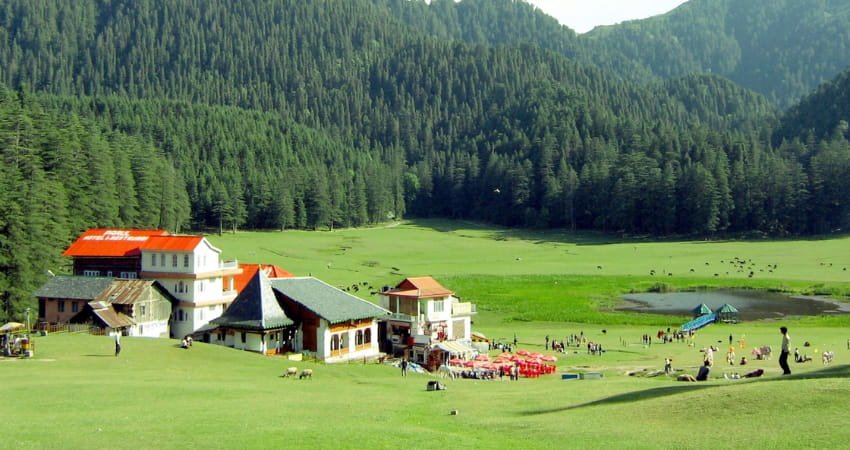
Calibrated for the coming 2026–27 winter and the spring 2027 season — with the 1992 Khajjiar naming story, the Gondola status and this season’s first snow built in.
The mini Switzerland in India is, officially, Khajjiar — a deodar-ringed meadow in Himachal Pradesh that was formally given the name on 7 July 1992, when Swiss envoy Willy T. Blazer placed a yellow Swiss hiking signboard showing the distance to Bern, and the Chamba administration recorded it among roughly 160 places worldwide with Swiss-like topography. That’s the documented answer.
But “mini Switzerland” has since been slapped on half the Himalaya — a meadow above Pahalgam, a ski resort in Gulmarg, a rhododendron valley in Sikkim, a monsoon trek in Nagaland, a ridgeline in Kausani that Gandhi himself admired. Some of those claims are nicknames, some are functional, and one is real. The eight places below are the ones that genuinely earn the comparison — but they don’t all deliver the same Switzerland, and they don’t all deliver it in the same months. This guide sorts the meadow from the ski slope, the green season from the snow season, and the day meadow from the week-long expedition.
In Short…
| If your Switzerland is… | Go to… |
|---|---|
| The official postcard meadow with a lake and pines | Khajjiar, Himachal Pradesh, April–June (snow late Dec–Feb) |
| A hilltop meadow above a Kashmiri river valley | Baisaran, Pahalgam, April–June or September–October (snow Jan–Mar) |
| Gondolas, ski slopes and real winter sports | Gulmarg, Kashmir, December–March |
| Snow meadows and snow treks, easily from Delhi | Chopta, Uttarakhand, December–February |
| Ski meadows with a cable car | Auli, Uttarakhand, December–March |
| Rhododendrons and an alpine valley | Yumthang Valley, Sikkim, late March–May |
| An offbeat trek and the endemic Dzükou lily | Dzükou Valley, Nagaland, late June–mid July |
| A 300-km Himalayan panorama over tea gardens | Kausani, Uttarakhand, October–March |
The Problem: “Mini Switzerland” Is India’s Most Abused Travel Label And It Books Wrong Trips
The trouble with this label is that everyone gets to print it. Khajjiar’s claim is documented — the 1992 signboard, the Swiss envoy, the distance to Bern etched in yellow. Baisaran’s is a local nickname for a meadow that looks the part. Gulmarg’s is functional: a genuine ski resort with a gondola climbing to nearly 4,000 m. Kausani’s goes back to Gandhi, who stayed on its ridge and left the comparison behind. And then there are the reels that apply the title to every green hillside with a pony in it.
Under one headline, you get four completely different trips:
- A road trip — Khajjiar via Dalhousie, one tank of fuel from Pathankot, a meadow you’ll photograph in the morning and leave by tea-time.
- A valley circuit — Pahalgam’s Baisaran, Betaab and Aru, where the “Switzerland” is one stop in a Kashmir holiday that also includes a river, a golf course and possibly a houseboat.
- A ski season — Gulmarg or Auli, where the Swiss-ness is measured in snow depth and lift queues.
- An expedition — Yumthang through a registered North Sikkim tour, or Dzükou on foot from a Kohima trailhead — places with permits, guides and their own calendars.
And the calendars genuinely disagree. Rhododendrons bloom in late March to May in Sikkim. The Dzükou lily peaks in late June and July in Nagaland. Khajjiar’s meadow is greenest in April–June and snowed over in January. The ski slopes of Gulmarg are alive exactly when Yumthang is buried. Book any of these on the label alone and you arrive in the right place at the wrong month — the single most common way these trips fail. Khajjiar has even made national news for it: tourists who showed up off-season and found a muddy field instead of the brochure meadow.
What This Guide Covers (and What to Know Before Planning)
This guide walks through the whole decision:
- Eight genuine Swiss-lookalike destinations, each with a Switzerland-quotient rating and an honest note on what it’s really for.
- The Khajjiar deep-dive — the naming story, how to reach it, and which months actually deliver the meadow.
- Season matching by region — Western Himalaya, Kashmir and the Northeast run three different calendars.
- Risks and rules — permits, gondola status, yatra-season crowds, altitude and monsoon roads.
- The booking order that prevents expensive mistakes, from tours to lift tickets.
Before you start, settle four things:
- Budget range. A Chopta weekend and a Kashmir ski trip share a headline but not a price tag.
- Trip length. Baisaran is a morning pony ride inside a Pahalgam stay; Dzükou is a two-to-three-day trek; Yumthang is a two-night tour from Gangtok.
- Date flexibility. The flower calendars and snow windows are strict; if your dates are locked, you may need to swap the destination instead of the month.
- Comfort with altitude and cold. Apharwat touches ~3,980 m; meadow nights in January run well below zero.
Step-by-Step Workflow: Choosing Your Indian Switzerland
The rest of this guide is a five-step decision process:
- Define your Switzerland moment (Step 1).
- Meet the headline answer: Khajjiar (Step 2).
- Compare all eight destinations side by side (Step 3).
- Match your months to the right region and its risks (Step 4).
- Sort permits, bookings and ground rules in the right order (Step 5).
Step 1 — Define Your “Switzerland Moment”
“Switzerland” means different things to different people. Name yours before you pick a destination:
- The meadow postcard — green bowl, lake, pines, cows-in-the-distance calm. Khajjiar is the canonical version; Baisaran is the Kashmiri one.
- The winter-sports Switzerland — gondola up, ski down, hot chocolate after. Gulmarg first, Auli second.
- The snow-without-skiing Switzerland — a white meadow, a walk, a photograph. Chopta in January, Khajjiar after a fresh fall.
- The flower Switzerland — spring blooms on an alpine slope. Yumthang’s rhododendrons (late March–May) and Dzükou’s lilies (late June–mid July) are the two great Indian examples.
- The panorama Switzerland — standing on a ridge and looking at snow peaks over green fields. Kausani, which Gandhi chose for exactly this, October–March.
- The offbeat Switzerland — the trekking version, earned on foot, shared with almost no one. Dzükou in bloom, or Chopta on a winter weekday.
Write down which of these is the point of the trip, and how many days you have. That combination narrows eight destinations to two or three before you look at a single fare.
Step 2 — The Headline Answer: Khajjiar, the Official Mini Switzerland of India
The story is precise enough to retell properly. On 7 July 1992, Willy T. Blazer — Vice-Counsellor and Head of Chancery of Switzerland in India, though travel writing usually promotes him to Ambassador — formally “baptised” Khajjiar as the Mini Switzerland of India and planted a yellow Swiss hiking signboard pointing out the distance to Bern, 6,197 km away. The Chamba administration’s records keep the event, and the popular account adds that Khajjiar sits on a shortlist of roughly 160 places worldwide that resemble Switzerland topographically. It is the only Indian destination whose claim is a dated historical fact rather than a marketing nickname.
The place itself earns it, in season: a saucer-shaped meadow at about 1,920 m, rimmed by deodar forest, with a small lake at its edge, lying inside the Kalatop–Khajjiar sanctuary. In summer it is exactly the postcard — green turf, pony rides, zorbing, paragliding, and the 12th-century Khajji Nag temple a short walk away. In winter, when snow settles on the bowl, it goes quiet and white. What it is not is a resort: there’s no strip of hotels on the meadow, which is precisely why it still looks like itself. The practical base is Dalhousie, 22–24 km away, and most travellers visit Khajjiar as the centrepiece of a Dalhousie trip rather than a destination of its own.
Getting there: roughly 570 km by road from Delhi; Pathankot is the convenient railhead, about 90–100 km away; the nearest airport, Kangra–Gaggal, is over 100 km. The last stretch from Dalhousie is a winding hill road that needs respect in the monsoon and after heavy snow.
And the honest caveat: the meadow has four seasons of which two are photogenic. April–June is green and pleasant; late December–February is the snow window. The monsoon (July–September) turns it lush but often misty, and the shoulder weeks can be brown and muddy — the “mini Switzerland” label has disappointed off-season visitors badly enough to make newspapers. Come in the right months and the signboard isn’t an exaggeration.
Step 3 — Compare All Eight Swiss-Lookalike Destinations
| # | Destination | Claim to fame | Switzerland-quotient | Best months | Permit | Ideal length | Budget pointer |
|---|---|---|---|---|---|---|---|
| 1 | Khajjiar + Dalhousie, HP | The official 1992 naming; meadow + lake + deodars | ★★★★★ | Apr–Jun (green); late Dec–Feb (snow) | None (Indians) | 2–3 days from Dalhousie | Mid-range hill-station pricing |
| 2 | Pahalgam: Baisaran, Betaab & Aru, Kashmir | Baisaran is Pahalgam’s “mini Switzerland” — pine-ringed meadow ~5 km from town, by pony or foot | ★★★★☆ | Apr–Jun; Sep–Oct (golden, quiet); snow Jan–Mar | None (Indians); check advisories | 2–4 days within a Kashmir circuit | Mid-range; peak during Amarnath Yatra |
| 3 | Gulmarg, Kashmir | The functional Switzerland: meadow resort + gondola Phase 2 to ~3,980 m on Apharwat | ★★★★★ (winter) | Dec–Mar (ski); May–Sep (meadows) | None (Indians); gondola must be booked ahead | 2–3 days | Upper-mid; lift passes and ski hire add up |
| 4 | Chopta, Uttarakhand | 2,680 m meadow under Tungnath (3,680 m, world’s highest Shiva temple) | ★★★★☆ | Dec–Feb (snow treks); Mar–Jun (green) | None | 2–3 days | Budget-friendly from Delhi |
| 5 | Auli, Uttarakhand | Ski meadows at 2,500–3,050 m with a ~4 km ropeway from Joshimath | ★★★★☆ (winter) | Dec–Mar | None | 2–4 days | Mid-range; ski courses extra |
| 6 | Yumthang Valley + Lachung, Sikkim | Rhododendron valley at ~3,560 m; Shingba sanctuary; Zero Point above | ★★★★☆ | Late Mar–May (blooms); Apr–Jun (best overall) | Registered tour mandatory; foreigners need PAP via operator | 2 nights from Gangtok | Fixed tour packages |
| 7 | Dzükou Valley, Nagaland | Rolling valley with the endemic Dzükou lily | ★★★☆☆ | Jun–Sep; lily peak late Jun–mid Jul | None (Indians); guides/entry fees apply | 2–3 day trek from Kohima | Budget trek pricing |
| 8 | Kausani, Uttarakhand | Gandhi’s “Switzerland of India” — 1,890 m ridge, ~300-km Himalayan panorama | ★★★☆☆ (views, not meadows) | Oct–Mar (clearest); Apr–Jun pleasant | None | 1–2 days | Budget-to-mid |
Reading the table: the five-star entries are five-star in different things — Khajjiar owns the image, Gulmarg owns the sport. The three-star entries earn their comparison in one dimension only: Dzükou in bloom season, Kausani at sunrise on a clear winter morning. The Switzerland-quotient is about the whole experience, and the whole experience is what changes with the month you pick.
Step 4 — Match Your Months to the Right Region (and Its Risks)
Unlike the islands in our mini-Maldives guide — which all live inside one October–May season — these destinations run three different calendars:
| Months | Western Himalaya (Khajjiar, Chopta, Auli, Kausani) | Kashmir (Gulmarg, Pahalgam) | Northeast (Yumthang, Dzükou) |
|---|---|---|---|
| Dec–Feb | Snow: reliable at Auli/Chopta, occasional at Khajjiar’s ~1,920 m; Christmas–New Year prices peak | Ski-and-snow season; Gulmarg at its best, Pahalgam white | Deep winter: Yumthang access restricted; Dzükou snowed and cold |
| Mar–May | Green and pleasant; April rhododendrons in the mid-hills | Spring: snow melts, meadows turn; April–June is the classic Gulmarg meadow season | Yumthang’s moment — rhododendrons late March–May; Dzükou pre-bloom green |
| Jun–Aug | Monsoon: lush but landslide-prone roads; budget season | Peak summer crowds; Jul–Aug overlaps the Amarnath Yatra — Pahalgam is crowded and security-heavy | Dzükou’s moment — lily peak late June–mid July, rain included |
| Sep–Nov | Clearest skies of the year; Kausani’s best window | Golden chinar autumn; September–October is the quiet-value window | October: Dzükou clearest, post-bloom; Yumthang winding down before snow |
The risk layer to respect before committing:
- Altitude. Gulmarg’s Apharwat top station sits at ~3,950–3,980 m — a sightseeing trip to serious altitude, where people routinely feel lightheaded and breathless. Yumthang is ~3,560 m, and Zero Point excursions run higher still. Treat both with the usual acclimatisation habits: hydrate, move slowly, watch for AMS symptoms.
- The gondola is a machine, not a mountain. Gulmarg’s Phase 2 spent stretches of 2026 shut for technical reasons and only reopened on 9 October 2026 — while Apharwat had already caught the season’s first snow on 13 October. If the lift is the centrepiece of your trip, check its status and book tickets online before you plan around it.
- Monsoon hill roads (Khajjiar’s approach, the Chopta corridor, Sikkim’s valleys) close or crawl after heavy rain. Daylight driving and a buffer day are the cure.
- The Amarnath Yatra window (July–August) transforms Pahalgam — prices, traffic and security checks all spike. If you’re not on the yatra, choose September or June instead.
- Kashmir winter closures are real: some roads and activities shut after heavy snow. Book refundable edges in December–February.
Step 5 — Sort Permits, Bookings and Ground Rules in the Right Order
- Fix the destination and dates against the season table (Steps 1–4). The calendars above are hard rules, not suggestions.
- North Sikkim first: book a registered Gangtok operator for the Lachung–Yumthang tour — it’s not a self-drive trip, packages are fixed two-night shapes, and foreign nationals need a Protected Area Permit arranged through the operator, with some high points off-limits entirely.
- Gulmarg lift tickets early: book the gondola online (J&K Cable Car Corporation) for peak dates, and re-verify Phase 2 status in the week you travel.
- Then hotels: Dalhousie and Pahalgam for the Christmas–New Year and May–June peaks, Chopta’s limited inventory for winter weekends, Kohima for the Dzükou trek.
- The Dzükou trek through a Kohima-based operator with local guides; entry and conservation fees apply, and foreign nationals should verify current Nagaland registration rules.
- Ground rules, the week before: IMD Mausam forecast for the district; district advisories for road status; cash for remote valleys; offline maps downloaded; buffer day added for monsoon and winter itineraries; and pony-ride/activity safety at Baisaran and Khajjiar taken seriously — the meadow views are not worth a fall.
- Use an AI assistant (ChatGPT, Gemini, Perplexity) to draft the itinerary and packing list, then verify every permit rule, tour requirement and opening status against official sources before paying anything.
Tools You Will Need
- IMD Mausam app / mausam.imd.gov.in — district forecasts, snow and rain warnings for every destination on this list.
- J&K Cable Car Corporation booking channel — Gulmarg gondola tickets, timings and live status updates.
- Registered North Sikkim tour operators + the Sikkim tourism portal — mandatory for Yumthang; handles the PAP for foreign nationals.
- State tourism portals (Himachal, Uttarakhand, Kashmir, Nagaland) — advisories, road status and yatra-season notices.
- IRCTC and airline sites — Pathankot trains for Khajjiar/Dalhousie; Srinagar flights for the Kashmir pair; Bagdogra plus shared cabs for Gangtok.
- Google Maps with offline downloads — valley roads lose signal exactly where you need the map.
- Booking platforms with free cancellation — for hill hotels in weather-dependent seasons.
- AI planning assistants (ChatGPT, Gemini, Perplexity) — for itinerary drafts, month comparisons and packing lists. Cross-check every claim they make against the official sources above before finalising.
Common Mistakes to Avoid
- Visiting Khajjiar off-season and expecting the brochure. The meadow earns its label in April–June and late December–February; the shoulder weeks have disappointed visitors publicly.
- Treating a reel’s “mini Switzerland” as a stay. Baisaran is a day meadow reached by pony — you sleep in Pahalgam, not on the grass.
- Planning Gulmarg around the gondola without checking live status or booking ahead. Phase 2 spent part of 2026 shut for technical reasons.
- Chasing rhododendrons in October or lilies in March. Yumthang blooms late March–May; Dzükou’s lily peaks late June–mid July. The calendars don’t move for your leave application.
- Treating North Sikkim as a self-drive trip. Registered tours are mandatory; DIY arrivals get turned around.
- Driving monsoon hill roads at night or without buffer days. The most common way Khajjiar and Chopta trips go wrong.
- Forgetting the Amarnath Yatra season. July–August in Pahalgam is crowded, expensive and security-heavy.
- Underpacking for the meadow nights. January at Khajjiar and Chopta means well below zero; Gulmarg’s slopes are colder.
- Ignoring altitude at Apharwat and Yumthang. Nearly 4,000 m is not a photo-stop altitude; hydrate and move slowly.
- Paying Christmas–New Year peak tariffs when March or September delivers the same views for less. Same meadow, better months, lower prices.
Results You Can Expect
Work through this framework and you should end your planning with:
- A destination matched to your actual Switzerland moment — meadow, snow, ski, bloom or panorama — at the budget and trip length you set in Step 1.
- Dates inside the correct regional calendar, with the three different season systems accounted for rather than averaged into one wrong “best time”.
- Bookings made in the money-saving order — tours and lift tickets before sell-out, hotels before peak, with the gondola’s status verified twice.
- Realistic expectations about what each “mini Switzerland” is — a documented meadow, a functional ski resort, a flower valley, a viewpoint — so the trip matches the photos in the right months.
- Meaningful savings by choosing March–June or September–October over the peak fortnights, and budget bases (Dalhousie, Chopta, Kohima, Kausani) over resort pricing.
- A verified, flexible itinerary with permits handled, buffer days built in, and every opening status confirmed against official sources.
Frequently Asked Questions
Which place is called the mini Switzerland of India?
Khajjiar, in Himachal Pradesh’s Chamba district — the only Indian destination whose claim is a dated, documented event rather than a nickname. On 7 July 1992, Swiss envoy Willy T. Blazer placed a yellow Swiss hiking signboard (showing the distance to Bern) on the meadow and formally named it the Mini Switzerland of India.
Why is Khajjiar called mini Switzerland?
Because of the 1992 ceremony, and because the landscape justifies it: a saucer-shaped, deodar-ringed meadow at about 1,920 m with a lake at its edge, set in the Kalatop–Khajjiar sanctuary. The Chamba administration records the naming, and the popular account adds that Khajjiar is one of roughly 160 places worldwide that resemble Switzerland topographically. The resemblance is seasonal — greenest April–June, whitest late December–February.
What is the best time to visit Khajjiar?
April to June for the classic green meadow, pleasant weather and the full slate of activities (zorbing, paragliding, pony rides); late December to February if you want it under snow. October–November is a good quieter window with clear skies. Avoid expecting the postcard in the monsoon or the brown shoulder weeks.
Does it snow in Khajjiar?
Yes — usually between late December and February, when the meadow and the Kalatop area receive occasional-to-regular snowfall. It’s at roughly 1,920 m, so snow is not guaranteed every week of the season (unlike Auli or Chopta, which sit much higher); check recent snowfall reports before planning a snow-specific trip.
How do I reach Khajjiar?
Base yourself in Dalhousie, 22–24 km away, and do Khajjiar as a day or overnight trip. From Delhi it’s roughly 570 km by road; Pathankot is the convenient railhead (about 90–100 km away) and Kangra–Gaggal is the nearest airport (over 100 km). The approach road from Dalhousie is winding — drive in daylight and add buffer time in monsoon and snow.
Is Baisaran in Pahalgam a mini Switzerland?
Yes — Baisaran is Pahalgam’s “mini Switzerland”, a pine-ringed hilltop meadow about 5 km from town, reached on foot or by pony. It’s a day meadow, not a stay: you sleep in Pahalgam and ride up for the view. Green and busy in April–June, snowy January–March, and at its quiet best in September–October, when the crowds thin and the light turns golden.
Which is better, Khajjiar or Gulmarg?
For the photo — Khajjiar. For the experience — Gulmarg, if you mean winter sports: it’s a real ski resort where the gondola’s Phase 2 climbs to about 3,980 m on Apharwat, versus a meadow you photograph. If you don’t ski and don’t want the gondola queues, Khajjiar in summer delivers the classic image for less effort and money. The honest answer depends entirely on your Switzerland moment.
Which is the cheapest or easiest mini Switzerland to reach from Delhi?
Chopta (Uttarakhand) — a 2,680 m meadow reachable on a budget weekend (~450 km), with snow treks in December–February and green meadows March–June. Kausani is the other easy option — about 410 km, spectacular views, budget-friendly. Both beat the Kashmir pair on cost and logistics and need no permits.
Do I need a permit for Yumthang Valley or North Sikkim?
Indian nationals don’t need a Protected Area Permit for Yumthang, but they must travel through a registered tour operator — North Sikkim is not a self-drive route; the standard is a two-night Lachung package from Gangtok. Foreign nationals need a Protected Area Permit, arranged through the operator, and some high points (like Zero Point) are off-limits. Check current rules on the Sikkim tourism portal before booking.
When do the rhododendrons and Dzükou lilies bloom?
Rhododendrons in Yumthang Valley bloom late March to May, with April the safest bet and the wider valley season running April–June. Dzükou lilies bloom from late June, peaking through mid-to-late July — the trek’s high season. Two different corners of the calendar: plan spring for Sikkim, monsoon for Nagaland.
“Mini Switzerland” is a title with one documented owner and several legitimate pretenders — but every one of them is seasonal. Pick your Switzerland moment first, check the regional calendar second, and let the signboard, not the reel, tell you when to come

