Devendra Kumar Budakoti & Swagata Sinha Roy
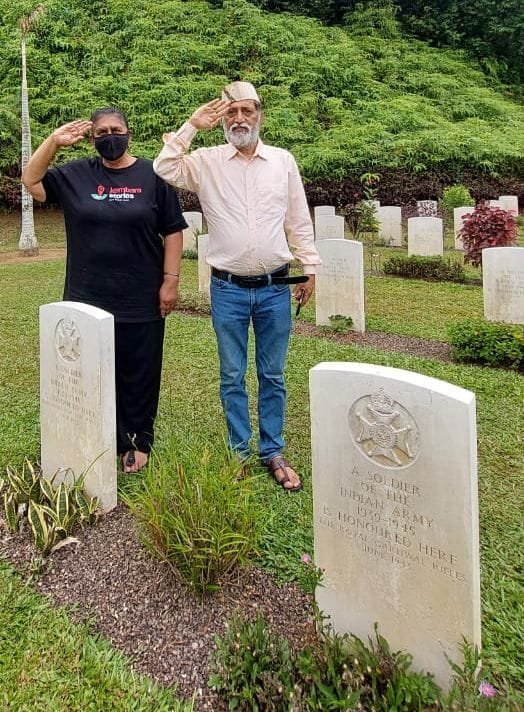
While visiting the Commonwealth War Cemetery at Taiping in the state of Perak, Malaysia, our thoughts turned to the Indian soldiers who were killed, wounded, or taken as prisoners of war (POWs) by the Japanese during the Malaya Campaign of World War II. Many among these Indian POWs later became part of the Indian National Army (INA), formed and led by Netaji Subhas Chandra Bose.
The Taiping War Cemetery stands as a memorial and resting place for Allied personnel who lost their lives during the Malaya Campaign of the Second World War. After the First World War, the British established the Malaya Command to coordinate the defence of British Malaya, comprising present-day Malaysia and Singapore.
With the outbreak of World War II in 1939, the Malaya Command was reinforced. The British Indian Army formed a substantial component of the Allied forces, with Indian soldiers serving in infantry, artillery, engineering, and support units.
A notable number of soldiers hailed from present-day Uttarakhand. Among them were the 2nd and 5th Battalions of the Royal Garhwal Rifles (now the Garhwal Rifles) and the 4th Battalion of the Kumaon Regiment, the then, the 4/19 Hyderabad Regiment.
Indian regiments, including the 2nd Battalion of the Garhwal Rifles and the 4th Battalion of the Kumaon Regiment, were drawn into active combat in December 1941. Despite inadequate preparation and serious logistical disadvantages, these units fought with courage and determination. Many soldiers were killed or wounded, while others were taken captive. In January 1942, additional units, including the newly raised 5th Battalion of the Garhwal Rifles, were deployed. Like many Indian Army battalions, they suffered heavy casualties, and survivors were captured as POWs.
It was from among these Indian POWs, and later along with volunteers from the Indian diaspora in Malaya, that the Indian National Army- the Azad Hind Fauj—was formed, under the leadership of Netaji Subhas Chandra Bose.
Many who died during the Malaya Campaign are commemorated at Commonwealth War Memorials in Changi- Singapore, and some at the Taiping War Cemetery, Malaysia. The Taiping cemetery is divided into two sections: one for Christians, marked by a Cross of Sacrifice, and another for non-Christians, marked as the Stone of Remembrance. More than 500 unidentified soldiers are memorialised by white granite headstones bearing regimental insignia.
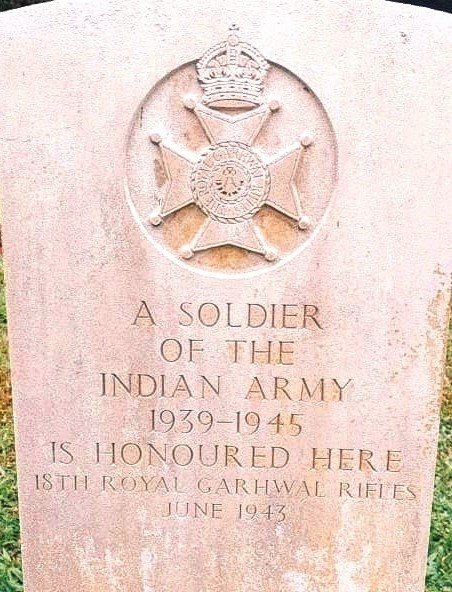
During our visit, four white granite headstones bearing the insignia of the Garhwal Rifles stood in a row, inscribed simply: A SOLDIER OF THE INDIAN ARMY, 1939-1945, THE ROYAL GARHWAL RIFLES, JUNE 1943. The peace and serenity and the cleanliness of the cemetery added to the entire pathos of war and sacrifice. These memorial stone evoked reflections on the social history of Uttarakhand, where men travelled across the world to fight in both the world wars, at a time when most people back home—especially women—had scarcely travelled beyond their villages. Today, the desire to see the world has become universal.
The author D K Budakoti is a Sociologist and Dr. Swagata Sinha Roy teaches in a University-UTAR, Malaysia
